What a braid layer actually does for torque control
Torque control is the property a clinician notices first. Rotate the hub and either the tip follows immediately, or it stores the rotation and releases it in a jump. The difference is almost entirely down to what sits between the inner liner and the outer jacket.
Why an unreinforced tube winds up
A plain extruded tube resists twist only through the shear stiffness of the polymer wall. Over a working length that resistance is low, so applied rotation goes into twisting the shaft before it reaches the tip. The energy is stored elastically; when the tip finally breaks static friction it releases at once. That is the jump.
What the reinforcement changes
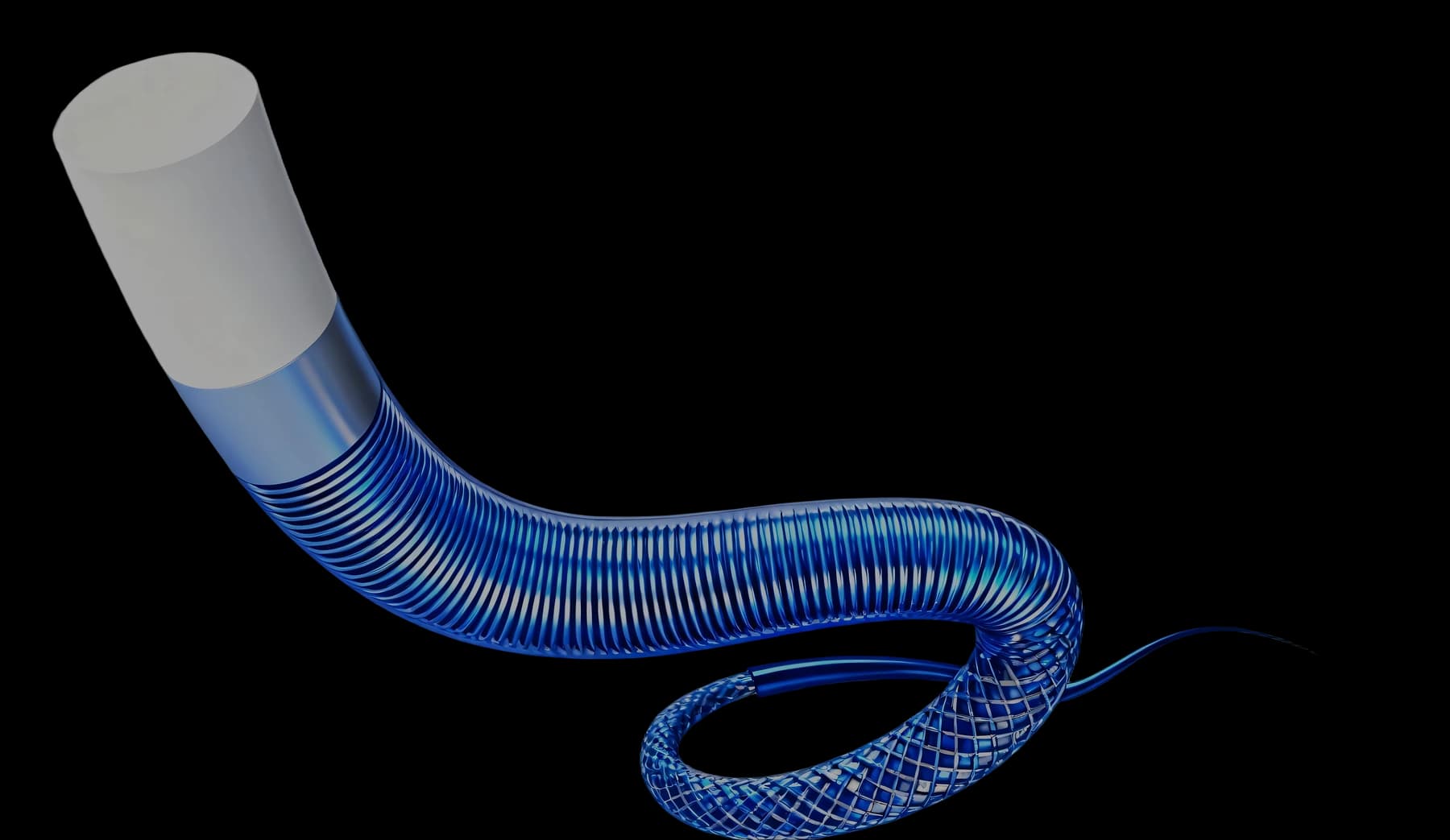
A braid or coil embedded in the wall carries the torsional load in the fibres rather than in the polymer. Because the fibres are laid at an angle to the axis, twisting the shaft tries to change that angle — and the fibres resist it in tension, which they are far better at than the polymer is in shear. The shaft becomes torsionally stiff without becoming stiff in bending, which is the combination you want.
Braid pattern and pick count set where you land: a tighter angle favours torque transfer, a shallower one favours flexibility and pushability. A coil resists kinking and keeps the lumen round but transfers less torque than a braid. Combining both in different sections of the same shaft is common.
Durometer segmentation
The other half of the picture is the outer jacket. Segmenting durometer along the shaft — stiffer proximally, softer distally — lets the proximal section carry push and torque while the distal section stays atraumatic and trackable. There is no fixed number of segments; the transitions are placed where the anatomy demands them.
What this means for a specification
If you are specifying a shaft, torque control is not a single number you can ask for in isolation. It comes out of the reinforcement type, the braid angle, the number and placement of durometer segments, and the liner. Describe what the catheter has to do — how far it has to reach, what it has to turn through, what it has to deliver — and the construction follows from that.